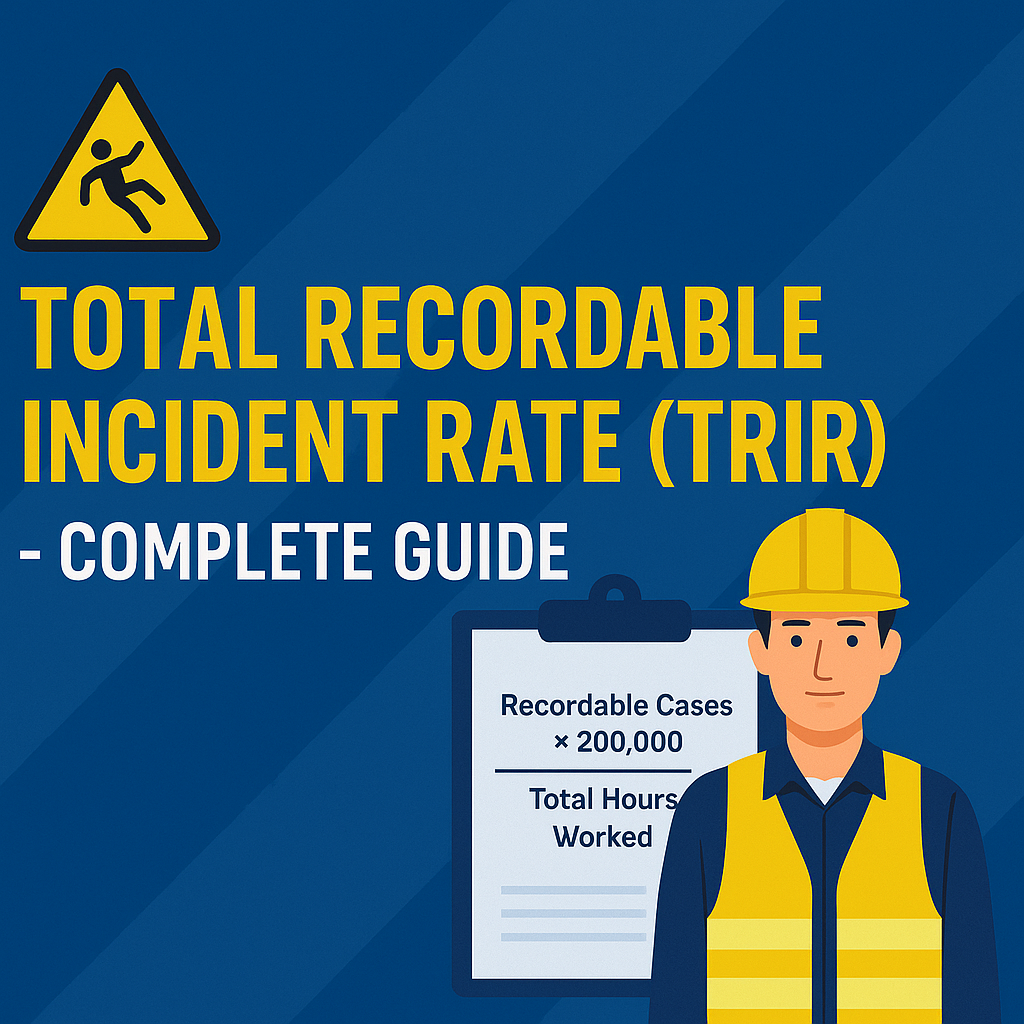
Total Recordable Incident Rate (TRIR) – Complete Guide for Safety Professionals
One of the most important safety performance indicators in occupational health and safety (OHS) is the Total Recordable Incident Rate (TRIR). It is widely used in the United States and internationally to measure the overall safety performance of an organization.
While Frequency Rate (FR) and Severity Rate (SR) are global standards (ILO), TRIR is derived from OSHA’s recordkeeping system. It shows the rate of all OSHA recordable cases — not just Lost Time Injuries (LTIs).
This guide explains TRIR in detail: definition, formula, calculation, importance, industry applications, case studies, FAQs, and free calculation tools.
🔹 What is TRIR?
TRIR (Total Recordable Incident Rate) is a safety metric that measures the number of OSHA recordable cases per 100 full-time employees in a year.
👉 In simple words:
TRIR tells you how many total recordable cases a company would have if it had exactly 100 employees working full-time for one year.
Recordable cases include:
- Fatalities
- Lost Time Injuries (LTI)
- Restricted Work Cases (RWC)
- Medical Treatment Cases (MTC)
❌ First aid cases are not included in TRIR.
🔹 Formula for TRIR
TRIR = (Number of Recordable Cases × 200,000) ÷ Total Hours Worked
Where:
- Number of Recordable Cases = LTI + RWC + MTC + Fatalities
- Total Hours Worked = Total hours worked by all employees during the year
- 200,000 = OSHA standard base = 100 workers × 40 hrs/week × 50 weeks/year
🔹 Why 200,000?
The 200,000 multiplier comes from OSHA’s calculation system:
100 workers × 40 hours/week × 50 weeks = 200,000 hours
👉 This allows companies of different sizes to compare safety performance on the same scale.
🔹 Example of TRIR Calculation
Example 1:
- Total recordable cases = 12
- Total manhours worked = 1,200,000
TRIR = (12 × 200,000) ÷ 1,200,000
TRIR = 2.0
✅ This means the company had a TRIR of 2.0 recordable cases per 100 workers/year.
Example 2:
- Total recordable cases = 5
- Total manhours worked = 500,000
TRIR = (5 × 200,000) ÷ 500,000
TRIR = 2.0
✅ Even though fewer cases occurred, the TRIR is the same (2.0) because the workforce size was smaller.
🔹 Importance of TRIR
- Key OSHA Metric – Widely used in the U.S. for compliance and reporting.
- Client Prequalification – Many clients require TRIR for contractor selection.
- Benchmarking – Companies compare their TRIR with industry averages.
- Performance Tracking – Helps identify trends in safety performance.
- Global Reporting – Even outside the U.S., TRIR is often requested by multinational clients.
🔹 TRIR vs IR vs FR vs SR
| Metric | Formula | Base | Focus | Region |
|---|---|---|---|---|
| TRIR | (Recordables × 200,000) ÷ Hours | 200,000 hrs | All recordables | OSHA / U.S. |
| IR | Same as TRIR (often interchangeable) | 200,000 hrs | OSHA recordables | OSHA / U.S. |
| FR | (Injuries × 1,000,000) ÷ Hours | 1,000,000 hrs | Frequency of injuries | ILO / Global |
| SR | (Lost Days × 1,000,000) ÷ Hours | 1,000,000 hrs | Severity (lost days) | ILO / Global |
👉 Note: Many companies use IR and TRIR interchangeably, but technically TRIR refers to the total recordable cases metric.
🔹 Limitations of TRIR
- Does Not Measure Severity – All recordable cases are counted equally.
- Lagging Indicator – Focuses on past incidents, not leading safety measures.
- May Encourage Underreporting – Some organizations may underreport cases to keep TRIR low.
- Not a Global Standard – Mostly used in the U.S. (though adopted by some multinational companies).
🔹 How to Reduce TRIR
- Strengthen reporting culture – Encourage near-miss reporting.
- Improve hazard control measures – Conduct regular risk assessments.
- Train workers regularly – Toolbox talks, refresher training.
- Provide proper PPE – And enforce compliance.
- Implement audits & inspections – Identify unsafe acts/conditions early.
- Leadership commitment – Strong HSE leadership reduces recordables.
🔹 Case Study Example
A U.S.-based oil & gas company logged 10,000,000 manhours in one year.
- Recordable cases = 40
TRIR = (40 × 200,000) ÷ 10,000,000
TRIR = 0.8
👉 The TRIR of 0.8 is below the industry average (example: 1.2), showing excellent safety performance.
🔹 FAQs on TRIR
Q1. What cases are included in TRIR?
👉 LTIs, RWCs, MTCs, and fatalities. Not first aid cases.
Q2. Why is TRIR important?
👉 It’s OSHA’s standard safety performance metric used in benchmarking and contractor evaluations.
Q3. Can TRIR be zero?
👉 Yes, if there are no recordable incidents.
Q4. What is considered a “good” TRIR?
👉 Lower than the OSHA-published industry average.
Q5. Is TRIR used globally?
👉 Primarily in the U.S., but many international clients also request it.
🔹 TRIR Tool – Calculate Online
We’ve made it easier for you to calculate TRIR with our free tool on 👉 The HSE Tools.
✅ Features:
- Enter recordable cases + total hours worked.
- Get instant TRIR calculation.
- Download a PDF report for your records.
- 100% free for safety officers, auditors, and students.
👉 Try now: Calculate TRIR Online – The HSE Tools
🔹 Conclusion
Total Recordable Incident Rate (TRIR) is one of the most important OSHA-based KPIs for measuring workplace safety. It shows the rate of recordable incidents per 100 workers/year, using a standardized 200,000-hour base.
When combined with FR and SR, TRIR gives a clear picture of how safe an organization truly is.
👉 Key takeaway:
- TRIR = Total recordables ÷ Total hours × 200,000
- Lower TRIR = Better safety culture
🔗 External Reference
OSHA Official: Recordkeeping and Reporting Requirements
Incident Rate (IR) – Complete Guide for Safety Professionals
Severity Rate (SR) – Complete Guide for Safety Professionals
Frequency Rate (FR) – Complete Guide for Safety Professionals
How to Calculate the Safe Working Load (SWL) of a Lifting Sling
Crane Safety: How to Calculate Capacity?

Md Selim gazi help me work job visa Canada diesel machine buch trick driver help me work job visa